Showing posts with label guest post. Show all posts

Wednesday, July 23, 2014

A Ghost Bike in Bloomfield

For anyone who knew Paul Hughes or is interested in showing support after this loss to Bloomfield and the cycling community I've added the information below on his funeral service and an associated memorial bicycle ride this Friday.

**********************************
Join us this Friday, Aug 1, Valley Cycling will host a ride to the funeral of fellow Cyclist - Paul Hughes at 10:15 out of Starbucks in Granby, CT (10 Hartford Ave). The ride to Paul Hughes Funeral will be slow, everyone will wear a black arm band - if you have one or can make one - bring it (piece of a black trash bag works fine).

Paul's service is at Old Saint Andrew's Episcopal Church, 59 Tariffville Road, Bloomfield - about .5 mile from where he was killed. Go past the ghost bike and take the Tariffville Road exit from 189 and go right at the end of the exit onto Tariffville Road. You will go down and then up a hill and see the church, a quaint, beautiful white New England structure, in front of you.  After the service, if anyone wants to visit the ghost bike and lay more flowers, please join Caryn Stedman in doing so.
**********************************
A reminder that we've got to look out for each other out there.
Heya folks.  Be careful out there, whether you're driving a car or riding a bike someone's life is on the line.  Looking at your lap for 30 seconds to check that random text message about cute kittens isn't worth someone else's life or livelihood.  A cyclist was killed last week in Bloomfield, and it probably wasn't an accident.  The cyclist was killed on a stretch of road that I've ridden often, and there is a wide shoulder.  I haven't seen the police report (if someone gets a copy I'll post it), but I'm guessing the driver was distracted and drifted into the shoulder striking Paul with the right corner of the car - where you see the damage to his truck in the news story.  Overtaking type crashes such as this are supposed to be very uncommon, but with distracted driving now the norm the trend may be changing.  Put down your fucking phone!  The fellow driving the truck may have been a nice guy, but now he's going to have to live the rest of his life knowing that he's murdered a fellow human being.
Note the huge shoulder!
The following information and photographs were provided by a friend of the cyclist that was killed, Caryn Stedman.

****************************************************
Ghost Bike Installed for Fallen Cyclist

Friends and fellow cyclists installed a “ghost bike” Tuesday morning, on southbound Route 189 in Bloomfield, near the Tariffville Road exit,  the site of the crash that took the life of Bloomfield resident and Maple Syrup maker Paul M. Hughes.  Paul was an avid cyclist who rode for the joy of riding and for his health. He often rode the Duncaster Road, Tariffville Road, Route 189 circuit, a popular cycling route for recreational, training and fund-raising cyclists.  Paul was killed Friday afternoon, July 18th, at about 5:15 p.m. when he was hit by a pick-up truck along a section of Route 189 with a wide shoulder well-marked for various fundraising bicycle rides.

Ghost Bikes, an international movement, are eerie, haunting memorials to fallen cyclists. They are placed at the site of fatal cycling accidents to remind drivers of the fragility of life, that cyclists have road rights, and to drive carefully.  Ghost Bikes help remember the life and love of the fallen cyclist, provide comfort for the family and friends, and remind other cyclists to ride safely. Hartford cycling activist and blogger Anthony Cherolis donated the bike.

Paul is survived by his wife, children and grandchildren, as well as his maple sugar and cycling friends, and his Spaniel, Henry. Hughes Maple Syrup is well-known in the Hartford area for its quality and flavor, a craft he in which he took great pride.  A memorial service will be held August 1 at Old Saint Andrew’s Episcopal Church on Tariffville Road in Bloomfield, just around the corner from where he was killed, on August 1.
For more information on the Ghost Bike movement, go to http://ghostbikes.org/.

Related Articles:

***************************************************

Read more!

Friday, January 31, 2014

Cycling and Hartford Conclusion


Cycling and Hartford: Coda

So where do we go from here? I don't know, because the big picture looks (note "looks" in italics, i.e. not "is") bleak. If I try to put a positive face on it, I could rationalize that pragmatism has also a positive flip-side and, that is, it's important to solve small problems first. Politics is often very adept at that, too, especially when it originates with grass roots movements. One hopes then that the chain of interlinking solutions to local problems then creates a new kind of attitude and practice (let's call it an ethos) that leads to even more significant changes. In this sense the Flower St. closing (in Hartford) is symptomatic of the larger problem of a more sustainable Hartford. The city and the state have built the busway in part because it will help relieve traffic congestion in the city. This is very good, of course, and it's also apparently in line with increased sustainability. At the same time, however, closing Flower St. to cyclists, pedestrians, and, in fact, local inhabitants essentially ignores the quality of life of these groups, who don't need the busway and who have the most invested in the city (because they live there). This is not sustainability. Some will argue that the street closing is a necessary tradeoff that serves a greater, public good. In pure numbers, perhaps this is true. Even if the busway were to serve many more people than expected and even if, then, these commuters were to frequent local businesses, etc… couldn't the city and the state have found a better solution than closing off the street? (The pedestrian and cycling detour is not just an inconvenience it's an added blight, also.) After all, isn't the best longterm investment and resource of a city the people that populate it? The Flower St. closing has been on my mind, not because I personally feel aggrieved by it, but because it is symptomatic of the things we need to do better.

The Italian philosopher, Antonio Gramsci, wrote that we must be intellectually pessimistic, but we must also have an optimistic will. With Hartford's rich cycling legacy, you would think that we would have a lot to build on for a sustainable future, beginning with the bicycle.

A short list of sources:

Russell Arben Fox, "Bicycling and the Simple Life." Cycling: Philosophy for Everyone: A Philosophical Tour de Force. Eds, Jesús Ilundáin-Agurruza & Michael W. Austin. Sussex, UK: Wiley, 2010:94-105.

Todd Balf, Major: A Black Athlete, a White Era, and the Fight To Be the World's Fastest Human Being. New York: Three Rivers Press, 2008.

Wiebe E. Bijker, "King of the Road: The Social Construction of the Safey Bicycle." Of Bicycles, Bakelites, and Bulbs. Toward a Theory of Sociotechnical Change. Cambridge, MA: MIT Press, 1995:19-100.

Italo Calvino, Invisible Cities. Transl. William Weaver. New York: Harcourt, 1974.

Connecticut History Online. http:www.cthistoryonline.org

Stephen B. Goddard, Colonel Albert Pope and His American Dream Machines. The Life and Times of a Bicycle Tycoon Turned Automotive Pioneer. Jefferson, NC & London: McFarland & Co., 2000.

David Herlihy, Bicycle, The History. New Haven: Yale U Press, 2004.
Read more!

Thursday, January 30, 2014

Cycling and Hartford Part IV


Cadenza/coda to come tomorrow.


Cycling and Hartford: Pt. IV: Build it and they will come?

But they don't have to, of course. We might be a nation that is ostensibly obsessed with gun "rights" when, instead, we should be more concerned with air and water quality, food security, and other pressing problems but these are the contradictions of "modernity" some might say. And we are definitely addicted to oil and gas but not necessarily because of natural causes but for historical reasons as we have mentioned before. As cities, like Hartford adapt and reinvent themselves does the bicycle fit into the changing urban landscape? Local associations and organizations like BikeWalk do their best to motivate cycle commuting, and we've even seen Pope-era kinds of developments in the second-half of the 20th C and in the first decade of this century in terms of cycling infrastructure. When I came to Hartford in 1966 (we lived on Webster St., near New Britain Ave.) the only cyclists I ever saw were "bicyclists", that is, children on "play bikes" and tricycles. The bicycle was basically viewed as a toy. No one. And I mean, no adult, rode a bike (at least in my very defective memory). As a teenager I bought my first ten speed (a French bike by the ominous name of "Unic Sport") and these were my wheels even after I got my driver's license. Sound familiar (except for maybe the "Unic Sport" part)? Fast forward (from the OPEC oil crisis of the early '70's when "economy" cars became popular in the U.S. and when commuting cycling became more prevalent) to our own time, we see more riders on the road. The infrastructure is much better, too, with the rails-to-trails movement, the Greenway, and consideration paid in many towns and cities to multi-use paths. In Hartford, marked bike lanes are intended to slow down car traffic and make cyclists more visible in some of the heavier trafficked intersections. All of this is thanks to advocacy groups working with local administrations. Urban cycling activists will often point to Portland and to several European cities and to the importance of bike share programs, etc… as instances of innovative urban planning, although in Portland it was more an epiphenomenon of the pre-existing cycling culture which won over city-hall. Ignoring our cold, wet winters, Hartford is uniquely suited for increased urban cycling because of its network of parks and its history with the bicycle. Yet, for all these opportunities cycling is not considered a means of urban revitalization in Hartford except by a small group of people. Implementing simple measures to improve conditions for cyclists would likely yield a more positive cost-benefit ratio in the long term than many other costly and ambitious public projects. More so, if we consider not only the effects for commuting cyclists, but for citizens in general (less noise and pollution). Moreover, even mass transit projects like the busway in Hartford is intended to serve people who do not necessarily live in the city, but suburbanites who make their living there. But is the difference between promoting less-costly innovative cycling projects and exorbitant expensive mass transit ones is that the former don't involve enough pork to make leaders and interested parties (who stand to gain from them) turn their heads. Unless cycling can quantitatively demonstrate that it can improve people's lives, enhance the real estate market, and create jobs (or at least be an important effect of it, as in Pope's day), it will be viewed by most as a marginal activity practiced by a "virtuous" (or foolish, depending on your perspective) minority of citizens (unless and until there is some critical threshold of cyclists).


Environmental and economic sustainability typically involves making tradeoffs, sacrificing something important and lucrative now for a longer term cost-saving objective. Shifting from gas to alternative energies is an expensive proposition, except in the longer term, as we know. And even if it were "impossibly" expensive, we might still have to do it. We often complain about the prices of things, but to sustain a quality of life for consumers and producers alike, we need to pay more for these goods and services. There are just too many negative hidden costs to our current lifestyle. But there are many sustainable choices that are actually far more fiscally smart and feasible in the short term, such as enhancing the cycling infrastructure, that would certainly be worth the price. It's an easy fix in other words. So, where is American pragmatism when you need it? Born in part from a frugal, hardworking, and dogged frontier mentality (also from the Protestant work ethic) American pragmatism conceptually works against sustainability because, by definition, "pragmatism" is primarily about the concrete and the present, not so much about the possible and the future. Think short term, not the long term. Consumer consumption, (since Thorstein Veblen theorized anyway) relies on an extreme version of pragmatism, now applies to a broad swath of the middle class and not just to wealthy elites . Think of the effects of it, the use and abuse of disposable goods filling up landfills. The most conspicuous of conspicuous consumptions is the mindless practice of accumulating unnecessary goods and disposing them irresponsibly as soon as they are no longer desired. Conspicuous consumption (which is the backbone of mass culture) is unsustainable.
So where do we go from here? Read more!

Wednesday, January 29, 2014

Cycling and Hartford Part III


More from Dario:

For the love of the bicycle

But before I explain what I mean by "And it gets worse", let's double back to an important love of our life: cycling? Cycling was born in England as an athletic, agonistic, class conscious, and elitist activity, not as an everyman, humble means of transportation. Only the wealthy, once upon a time, recreated. So, it makes sense that mastering an Ordinary (a high wheeler, a "Penny-farthing") would require the extensive leisure to do so. This was initially the case in the U.S., too. Mark Twain famously tried, unsuccessfully, to tame the tall beast, but he could afford the time and expense to learn how to ride (if he had only really tried). Cycling up until about the mid-1880's was the stuff of mainly well-to-do men and a few iconoclastic women. When eventually prices dropped for these expensive contraptions, people of lower social classes could afford them. A middle or even working class man on a high wheeled Ordinary riding alongside an aristocrat on a horse would literally see eye to eye. Metaphorically, the playing field had been leveled (and never underestimate the power of metaphors). When Pope began producing his version of the "Safety" bicycle, that is, the classic diamond shape design with two wheels of equal diameter, everything changed. Although expensive at first, prices dropped as competition from other producers, a more efficient production process, and the sheer volume of bicycles made and sold in the U.S. increased. Pope's genius was also in having promoted the production of the step-through version of the Safety bicycle for women (in the background of the image of the male Safety), thereby, opening up a huge market and also contributing, as Susan B. Anthony proclaimed, an important instrument to the promotion of women's liberation. Histories of the bicycle are filled with references to the democratizing effect of the bicycle.
Cycling in the 1890's was all the rage in the U.S. and elsewhere, especially competitive cycling. Major Taylor was perhaps the first, truly international American superstar athlete. And he was black. The League of American Wheelmen had been created in 1880, the mother of all affiliate clubs throughout the country. There were velodromes in many cities and major competitive races, track and road, including a velodrome in East Hartford. Pope promoted good roads and cycling parks to enhance the market for bicycles. Seemingly inhuman speed and endurance races captivated the American and European imagination from about the 1890's into the beginning of the 20th C. Then the bottom fell out, as they say. Cycling declined in popularity with respect to the initial craze. Certainly a less costly automobile (Ford's car for everyman as opposed to Pope's car for the wealthy) began to dominate the landscape. But this doesn't explain why we jumped into cars spending a lot more money and not using bicycles, for example, for commuting short distances, as happens everyday in many cities around the world. Marketing, irrationalism, desire to be better, faster than your neighbor, or even inertia are all logical and possibly good reasons. Time is money.

To answer this, perhaps we need to look at our own era. First, Greg Lemond, and then Lance Armstrong (however steep his fall from grace has been) helped make road racing enormously popular in the U.S. While they certainly contributed to the production and sales of higher end racing machines, did they actually contribute to cycling, meaning, recreational and commuter cycling? Did the people who went out and bought an expensive racing machine, ride outside of this specific conspicuous consumer activity (racing, fast club riding)? There is an uncanny parallel between the cycling paradigm in Major Taylor's era and in our own. Has this predilection for agonistic cycling been an impediment to the development of the bicycle as a means of transportation in the U.S.? And if this is true for us, why isn't it true for some countries in Europe, where there are many commuting cyclists?

At the end of the last post, the reflective interlude, I intimated that "And it gets worse", which I reprise in the introduction of this entry. If sustainability is about making conscious choices and mainstream American society and culture actively avoids sustainability, then this impulse to avoid is not only because of economic opportunism, but avoidance has also become an ingrained habit and even a cultural norm with ideological underpinnings. Indeed, things get worse. Read more!

Tuesday, January 28, 2014

Cycling and Hartford Part II


Dario continues:

Cycling and Hartford: Pt. II: Col. Pope and the Paradox of Progress

Hartford. 1895. Albert Augustus Pope, a Civil War veteran and Boston entrepreneur intuits that the cycling craze is at its height. Besides being a brilliant and savvy businessman, Pope, from a distinguished line of Boston entrepreneurs (mostly, lumber) has a sixth sense about these things. The commercial apex of the bicycle in the U.S., with literally hundreds of Columbia bicycles churned out on a daily basis at the Pope Manufacturing Co. on Capitol Ave. in Hartford is the sign that the apex is also the zenith. Pope puts his hopes and business acumen into the electric car. He even buys out George Selden's patent for the gasoline engine to head the competition off at the pass. But Pope's electric car doesn't catch on because the electric companies can't really see a profit in installing stations for charging the engine batteries. Plus, batteries don't hold a charge for long. Instead, there is plenty of gas in the earth and fewer technical issues with those filthy, greasy, smoking engines. Pope eventually sells a part of his claim on the patent to a cartel of fledgling car companies, perhaps with the idea that he can still maintain some profits and royalties. Henry Ford, as we all know, will eventually win the day, of course, stealing Selden's gas engine and thumbing his nose at the competition, and finally crushing his adversaries, including Col. Pope, in court. 

For a moment though, a brief moment, Hartford was not only the bicycle capital of the U.S., but also the automotive capital. (We could have been driving electric cars in 1900 and Lord knows what the technology would be like today!). Pope's legacy, beside Columbia bicycles and Pope cars, is that he created the Great Roads Movement. To sell more bicycles, Pope understood that we would have to improve the rutted, rocky dirt lanes that were just good enough for horse carts. Thus, the "roadification" of the U.S. was Pope's dream for the bicycle. And even after he formally retired from making bicycles and cars, he continued to promote and to lobby for paved roads throughout the U.S.. 

In the following image looking toward the state capitol, Pope Manufacturing, Capitol Avenue, we see the Pope factory on Capitol Ave (on the left) and the housing Pope built for his skilled workers (on the right). In this link, I-84 viaduct, you can see the area in the foreground where the Pope Manufacturing Co. once was. You can also see quite obviously the I-84 viaduct that bisects the city and gargantuan Aetna which rises beyond. Could Pope have foreseen this development, a day when there would be as many roads as, if not more than, people? How many occupants are in each of those cars? How much space is required for each of the vehicles? Was this Pope's and Ford's view of progress? From the perspective of aesthetics, the environment, and sustainability, the road to Hell is paved with good intentions. Plus, we ain't allowed to ride our bikes on the interstate.
Read more!

Sunday, January 26, 2014

Cycling and Hartford Part I


In a departure from the junk I usually write about cold feet, some slight by a faceless driver or comparisons of eggs and pedals we will feature some guest posts by Dario about cycling and the history of Hartford. One may not think about Hartford's rich cycling past when riding around these days because it's been obscured and generally erased by years of pro-car planning choices and neglect. So, read what Dario has written and either get depressed about once was or hopeful that our city can rejoin its past and have roads dominated by people and not machines.

Cycling and Hartford: Introduction

As everyone knows, Hartford was once renowned for its manufacturing and not only for its insurance companies. I've dipped into a few books about cycling and about Hartford during the late 19th and early 20th C and they got me thinking. Cycling was all the craze because human-powered locomotion was exciting, and man had never gone so fast. Cyclists were even beating horses in races. The craze fizzled quickly however, lasting only about 15-20 years (ca. 1880-1900), with the development of gas engine vehicles, the car in the early 20th C, and then, of course, with the Wright Bros. flying invention. Cycling enjoyed its heyday, like Hartford (although the city's fortunes began long before and lasted long after). And then it was over! It's fascinating and also a little sad. We have come to accept the excuse that cities everywhere have their great moments and then they decline, whether it's the small northeastern manufacturing town or the sprawling industrial cities of the Midwest. Cities are places where people make lots of money.

Take Albert Pope, for example. The bicycle and then auto entrepreneur-magnate did much to help Hartford. He was in it for profit, too, of course. But he also had a sense of people and of the place. When the capitalist winds shift (that is, industries come and go), cities' fortunes often shift with them, and the same occurred in Hartford to a great degree. In the next several "posts", I want to briefly reflect on why cities change. And I also want to reflect on cycling, too. But I also want to reflect on memory and time in terms of cycling, the city of Hartford, and the prospects of sustainability. That's a lot. And it will be confused. But, hopefully, it will also be a little interesting.

Cycling and Hartford: Pt. I: "Why cities change?"

Cities change because they are living organisms. When we first think of cities, we think of buildings, roads, commerce, finance, entertainment. Cities are places of exchange and intense interactions between and among people. But unlike their inhabitants, cities typically have a longer, much longer, life cycle. But they, too, eventually exhibit similar life patterns, without necessarily dying off completely. It would be far too easy, therefore, to apply biological necessity to cities in order to explain why they change and decay, something along the line of, "cities must also die in order to be reborn and to thrive again." (This is true in the animal kingdom in order to perpetuate the species, but not of the places and structures created by animals. Animals and humans tend to exploit their environment and then move on. Cities do have economic ups and downs.) But there is no guarantee that once fallen they will rise again. When it comes to cities, we human beings have adopted a scorched earth policy throughout history. When cities die, they do so not because they die a necessary, natural death, but because people kill them off with the choices they make. Why do some cities, great cities continue to thrive, whereas others suffer virtual, if not real, deaths, like what seems to be taking place in Detroit? 

Urbanists and economists can explain the mechanics of a city's decline. The anthropological explanation of why major cities continue to do well, change, adapt, is because the different generations of inhabitants, whatever their own values and cultures, are personally invested in the city. They make it work. Cities die as the result of lost income (again, bankrupt Detroit) apparently, but because those with money (and not only the very wealthy) don't really care, despite the rhetoric. Otherwise, why would important corporations, for example, that are essential to the life of a given city up and leave. A city's sustainability requires a population that is invested in it. One reason why Hartford, despite its woes, is still "on the map" is because the city's longstanding institutions are still heavily invested in it, meaning, that they can't just get up and move out, like companies that move production elsewhere. It's a relatively small city with a rich legacy of cultural and educational institutions and important industries. Yet being a relatively small city with a dwindling tax base, Hartford faces significant challenges. The possibility of moving to a regional tax base to support Hartford's infrastructure is highly unlikely, although it would be the "right thing" to do economically and morally (because many people work in Hartford, but live in the wealthier neighboring suburbs). It would make the city more sustainable in transportation planning, too, for example. 

Only in recent decades do we care about the concept of sustainability and how it relates to urban areas. When resources were considered infinite (perhaps up through the 19th C and before the energy crises of the 20th C drove the point home about the limited fossil fuels), we could view cities as if they were like consumer goods, destined to be obsolete. But not anymore. Hartford, for example, has changed dramatically, from one of the great manufacturing centers to an impoverished city (albeit with lots of resources still). Hartford had and has everything going for it in terms of geography, access to important technologies and education, and an extensive infrastructure that serves not only its inhabitants, but also the many people that come in from the suburbs to work there. So, what is its problem?
Stay tuned for Part II
Read more!

Wednesday, August 28, 2013

In Praise of Expedition Speed: A Sort of Ride Report of the 115km route of D2R2.

A guest post from Dario about the D2R2, because I wasn't there to see how it was:

The ride couldn't have begun better. Sandy Whittlesey (D2R2 founder and promoter) and his progeny, Fin, smiled at our motley, nearly arthritic crew. We knew then and there that it was going to be a great day of riding. Accompanied by friends Dave and Ken, Peter, Bruce, and I rolled out at about 9 am on one of the most perfect days of riding this summer. The different routes of the D2R2 all have their challenges, namely many steep hills and lots of loose gravel and sand. There is also the most incredible scenery and certainly some of the nicest people you'll ever meet, anywhere. I saw other riders, more fit than I, young and old, hammer up and fly down hills with 6%, 8%, 12%, 15%, 20%+ grades. (Personally, I refuse to go down anything steeper than 20%, even if I make it up the hill to begin with.) D2R2 is renowned for the hard men and women who tackle the 150km and 180km routes. But it's chief accomplishment is to bring together under one tent (literally) the different kinds of cyclists (racers, experienced randonneurs, tourers, and supposedly fit recreational riders, such as my companions and me), in what is easily one of the great cycling events around. (Granted I don't do big group rides much and I don't get out much.) So, rather than sing the praises of the seasoned racers and the bikes of the famed frame builders present at D2R2, I'd rather chant the virtues of expedition speed and its well-intentioned practitioners.

What is expeditions speed? It's all relative of course, but it's as fast as you can ride in six inches of snow without blowing up. It's making it up Patten Hill Rd. (a very steep, longish hill on the D2R2 course) with a smile at the top. It's riding the flats at conversational speed. You have to be able to chuckle, if not laugh, at expedition speed. It's making sure that you are all together especially when someone is a little slower. It's when the fear of suffering is worse than the suffering itself. It's stopping when you can because you can. You know that you are at expedition speed when one of your mates stops to take a pee and before he can say "go on, I'll catch up to you guys", everybody is stopping for a nature break. Expedition speed is about the clock, but not about besting your record, but about making sure you're home for supper in time. "Chi va piano, va sano, e lontano" goes the Italian saying (He who goes slowly, goes safely, and far) is the way I put it. And, there is, very fortunately, different ways of riding at expedition speed.

For example, my fellow expeditionists and I recall the amusement provided by the jeep track, just off Packer Corner Rd at about mile 19 of the course. Y'know, the one that's marked with a very evident "Posted" sign on the tree. By the time we reached the exotically named Abijah Prince Rd, which according to Sandy W.'s cue sheet, reads "Jeep track gets more civilized", we were already nostalgic for the barbaric singletrack section we had just ridden. Bruce, I realized, is a consummate artist at riding in surplace. Using less than one to one gear ratio, he is able to negotiate obstacles and steep pitches by keeping up a consistent rhythm. It isn't as easy as it sounds. If I were to go that slow, I'd fall over.

If you ride slow enough in any case the major climbs begin to resemble one another and this in a curious time-warp continuum way can prolong your ride and, hence, your life. You can try to go fast up Ames Hill Rd (mile 29), Pennel Hill Rd. and Phillips Hill Rd (miles 49, 51) and the previously mentioned Patten Hill Rd (mile 58) and then when you realize that you've used up all your gears you stop, lean over the bars, feel like you can't go on, catch your breath, and then pedal some more. And if you apply this tactic assiduously, you eventually get to the top of the hill. I hadn't realized that Ken had perfected this art. He was our trailblazer and he frequently paid for being so avant-garde. Once recovered, he bounced back to his immense credit and deep satisfaction.

Now let me tell you how real expedition speed cyclists approach Pennel Hill Rd., which is an excuse for a road, by the way. It's really a long sandbox set at a 15% pitch. Turning right off of Rte. 112 S, Bruce declared that we should gear down. As Sgt. Rock might say, "Smoke 'em if you got 'em". I mean it's not like I had been in the big ring all day. So, we made lots of crunching and grinding noises while sliding around in a few inches of sand as we rode in circles at the bottom of the hill. A flock of ducks crossing the road? Or more likely, we resembled the newly arrived souls on the shores of Purgatory. We knew we had to go up the mountain, but we would rather have hung out at the beach. As each of us tried to make our way up the hill, I happened to remember (about 100 meters up, DUH!), Jan Heine's advice about very very steep hills: Sometimes it's faster to get off and walk. Sage advice. So I walked fifty yards or so. I cleared the rest of the hill, but only because I wouldn't allow myself to roll backwards.

There were many other memorable moments in which our well-honed expedition speed techniques were put to good use. As Sandy emphasized in his pre-ride email, try to stay within your limits and you will enjoy yourself immensely. This we did. Thank you Sandy!

Look at that smile! And that was before the ride.

Read more!

Thursday, June 13, 2013

Polysemous Cyclists

Dario took the bait and here is the responding guest post.  Let's roll this idea around a bit more.

***************************************************************

     Tony's eloquent post (Sun., June 9, 2013) launching from verses by Wallace Stevens and landing on a topic, sustainability, which is dear and near to beatbikeblog readers seems at first a stretch. But as I re-read his post, I begin to see interconnections that I think we can develop further. If Stevens did indeed compose his lines while walking to work in the morning and back home in the evening, he wouldn't be the first peripatetic philosopher-poet in Western civilization. Homer, Dante, and Whitman immediately come to mind. But there are so many others. All of them great travelers. Stevens perhaps less so, although he didn't need to travel as far and wide in order to gain perspective on the world. Like Dante, Stevens is a keen observer of the small, the incidental, and of happenstance. For both poets, nothing, however, is ever really small, incidental, or just the result of happenstance. Everything is pregnant with meaning. The "thin men", the "blackbirds", the "golden birds" from the seventh stanza of Steven's Thirteen Ways of Looking at a Blackbird are polysemous, that is, they can mean many things to many people.

    Imagine Mr. Stevens who was quietly but fervently skeptical of absolute and universal belief systems walking along Asylum Ave. thinking such thoughts. At the time of the poem's publication in 1917, Stevens had recently taken up his post at The Hartford insurance company. World War I was raging. Bolsheviks were taking over Russia. Labor strife in the United States. Revolutionary ideas. Hartford with its history of craftsmanship and industry and also finance was a flourishing city. But not all was golden. Stevens was politically conservative, but he was a radical thinker nonetheless. He had a deep sense of the overarching paradox of our lives that bind all of us together, rich and poor. Of necessity, the poor have to enjoy the "little things" in life. But conversely, if the rich cannot or are unwilling to see the grandeur in the small and in the ordinary, then they are blind and truly impoverished. Lao Tzu reminds us: "Have little and you will gain./Have much and you will be confused."
           
     In his post Tony writes: "If you want to live a happy and sustainable life, it seems important that we recognize our nearby and local treasures." I'd argue more forcefully: "Without cherishing our surroundings we cannot endure." This is why walking through Hartford (as Wallace Stevens did) and cycling through its streets (like the beatbike bloggers often do ) is necessary and not just important. Without assiduously casting our gaze in purposeful seeing (analogous to the way we view works of art, let's say, or the famous sights of the world's great cities) can we ever fully appreciate where we live? I'm reminded of this question, Tony, when on our rides we see a side of Hartford not seen by many others. The actual experience of seeing is often a catalyst for the imagination and, vice-versa, the imagination inspires our ways of seeing things. Sustainability and, more ideally, happiness require the use of imagination. Perhaps Wallace Stevens didn't need to walk along Hartford's streets in order to create his introspective art. Perhaps he saw the thin men in his mind all along or maybe while walking he saw all too many thin men (real ones and metaphorical ones) that inspired his poetry. For beatbike bloggers, cycling is a catalyst of the imagination and of our own individual sustainability.


***************************************************************
Any other aspiring literary cyclists out there in Hartford or regions further?  If so, how goes your appreciation of blackbirds?  Does your imagination seem to be sustainable?  Are you feeling anti-social
Read more!

Friday, January 11, 2013

Two Cheers for Anarchism and for Cycling, too!

Dario joins us again with a guest post!


I read a book recently that I think might be of interest to some of our Beat Bike Blog readers. Two Cheers for Anarchism: Six Easy Pieces on Autonomy, Dignity, and Meaningful Work and Play (Princeton, NJ: Princeton UP, 2012) by James C. Scott, a distinguished Yale anthropologist, is a highly readable and thought provoking reflection on the importance of anarchist thinking in different spheres of life. Although Scott does not discuss cycling culture in his book, many of his points are relevant, especially to cyclists who commute regularly and who are passionate cyclists. So, after briefly summarizing some of the books contents, I'd like to relate it back to cycling and, in particular, to Tony C.'s interesting post about cycling and radical thought (See Dec. 12).

The first part of the title might be slightly misleading for some readers. Two Cheers for Anarchism is not a manifesto for political anarchism as we might think, although Scott does refer back to some of the historic thinkers and movements in his preface. Nor is Scott a crass libertarian, inveighing against big government and taxes and claiming that the free market is the solution to all of our social and economic problems. The second part of his book's title more accurately captures the objects of his reflections: autonomy, dignity, and meaningful work and play. Written in a conversant style and divided into short chapters which he aptly calls fragments, Scott roams freely and widely, moving from topic to topic like a moral essay in the style of Montaigne or of the French philosophes. Among his many topics, he discusses the importance of insubordination in organizations, the pathologies of institutional life, society's bizarre and often unproductive notions of quantity (as opposed to quality), and the importance of breaking rules. I especially enjoyed his fragment (no. 11) in which he describes how in the immediate aftermath of WWII Danish architects designed a playground for children in a public housing project in Emdrup that promoted creativity. Rather than build a conventional playground with swings, seesaws, etc... these Danish planners noticed that children had more fun and were more active when they were simply given the raw building materials to build their own playground. The same kind of creative autonomy can be seen in certain toys of our youth, such as Legos building blocks (and for you older readers, Erector sets). In the same fragment, Scott goes on to explain why Maya Lin's Vietnam War Memorial in Washington, D.C. is such an effective piece of public art: "I believe that a great part of the memorial's symbolic power is its capacity to honor the dead with an openness that allows all visitors to impress on it their own unique meanings, their own histories, their own memories." (p.62) Many of Scott's reflections, such as the two that I just reported, will seem like commonsense to readers, but they aren't any less insightful and truthful. His merit is to have written a cohesive narrative of how basic themes of anarchist thinking are present in our own society and in people who wouldn't see themselves as anarchists.

Passionate and committed cyclists can relate to many of Scott's points and our experience can also enrich some of his reflections. For example, the creative freedom of wandering we've all felt as cyclists. One of my great pleasures is exploring the urban wilderness of Hartford with friends, discovering new paths, stopping to observe vistas of the CT River that are precluded to car drivers, and learning about how much the city has to offer. And think of the qualitative contacts we make daily because we are more exposed to pedestrians and to the environment. I couldn't help thinking about Tony's post, that cycling promotes radical thinking, not necessarily and only in the political connotation of Left wing radicalism. Rather, cycling promotes radical thought in the real sense of the word. It promotes a "rootedness", a qualitatively different experience from the alienation of consumerism. Are all cyclists anarchists therefore? I don't know. I do believe that cycling does promote individual creativity and resourcefulness that seem to be a hallmark of anarchist thinking. Read more!

Sunday, August 19, 2012

Bonus Sunday philosophy post: Is Cycling a Constitutional Matter?


Dario sends this along to be posted:

Dear Tony,

Thank you for posting my response to the NPR segment dealing with bicycle culture in the U.S. ("NPR and Velosophy", August 4, 2012). And thank you to those that posted comments. If I may, I wish to respond and to elaborate on those comments because each commenter posed an interesting problem or perspective. My aim is to promote further discussion.

I wish to respond to what I see are two main issues in the comments: conceptualizing cycing culture (excuse the alliteration) and the relationship between consumerism and cycling. I will also try to respond to your (Tony's) three recommendations for improving cycling culture, I asked you, "If you were king for a day, what three things would you do ...?" and you responded succinctlty. I wish to discuss your recommendations. I'll limit this post to discussion of the first point (about conceptualizing cycling culture) and deal with the other topics in subsequent posts if that is all right with the blogs' editors.

Gabriel Sistare in his comment to my "post" writes that the mayor of Bogota, Colombia, Enrico Penalosa, has taken an innovative position about cycling. It would seem that Penalosa's view about cycling (vis-a-vis cars) is far reaching. Can you imagine taking Penalosa's view and informing American drivers that the right to park is not constitutional? Car drivers often behave as if it is their right to rule the road. Asphalt roads were created for driving cars, in fact. So, drivers must rule. But between the two, cars and bicycles, the mayor of Bogota has rightly deemed that bicycles are the more ethical means of transport because (I'll assume) they occupy less space, do not cause pollution, and are overall safer for the riders and other citizens on the street. And they reduce urban congestion. The one thing I disagree or, rather, wish to challenge Penalosa (and Gabriel perhaps) is on whether or not cycling is a constitutional matter. They seem to think not. I differ. I will make a case (likely an extreme one) for cycling being a constitutional issue.

Bicyles and arms (guns, forget about swords) have a lot in common. The BeatBikeBlog is based in Hartford, historically the city of Colt firearms and of Pope bicycles, two industries and two technologies that are intertwined. Guns are a polarizing topic. The bicycle, thankfully, less so, unless you live in NYC. The debate today about the right to bear arms has never been more heated and relevant especially because of recent tragic events. When the writers of the Constitution included the second amendment about the right to bear arms, they had a specific historical context in mind: to protect the citizenry against despots and tyrants and to be able to form militias against would-be usurpers of power. Our founding fathers had a lot more good sense than we do, so they didn't legislate transportation. They left that for us. Cars and bicyles had yet to be invented. But bicycles, like cars, are a sophisticated technology, not to the same degree as the automobile, but they are sophisticated because of the materials, design and construction. Cars, in particular, are arguably a weapon, not unlike guns. Whereas, fortunately, it is illegal for me to wave a gun around in public, there is considerable leeway in how I am allowed to use a motor vehicle. Road rage and indifference with mortal consequences (See Ken Krayeske's post about Mr. Harrison's death.) are just two instances of how the car is frequently a weapon in the hands of some people. Aside the occasional "scorcher" (the nineteenth and early twentieth-century term for rogue cyclists who terrorized the streets), cyclists rarely do harm. The bicycle is not technically a weapon because of its scale (speed and size) and because of its humanizing quality about which I talked in the last post, unlike many, especially, larger motor vehicles. Most cyclists are automobile drivers and would never think of their motor vehicles as a weapon. Most car drivers who don't cycle also don't think of themselves as engaging in a ballistics arms race when they drive. But how many drivers choose to purchase a vehicle for its defensive capabilities (the SUV versus the compact car in case of an accident)? That is a weapons choice, defensive, but still a choice about object/subject relations in terms of potential violence and harm. That is not generally how cyclists choose a bicycle, I think. When our founding fathers included the second amendment about the right to bear arms, they thought of protection. Hence, cars are analogous to, if not like, guns. Whereas the bicycle is not. Nonetheless, because cyclists and bicycles necessarily share the road … Well you get my picture. As I said, I'm trying to push the limits of discussion, but I don't think we can dismiss the argument entirely. What do you think? Read more!

Tuesday, November 2, 2010

Guest Post: IL to CT Part II

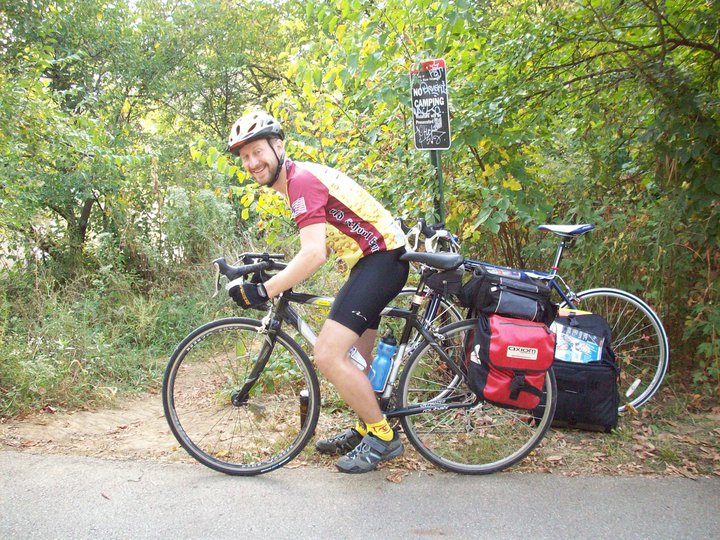
Editor's note: Here's part two of Tony's trip to CT. He joined us for The Eel on Saturday and it was nice to meet him. Since I couldn't get his picture of a map to upload, included is some picture I took of some stuff near NW CT.

Chambana to Connecticut in 16 Days - Part 2

Well you’re back for more. Glad to share and I hope this article inspires others to try a multi-day self supported bike tour. If you missed the first installment, you can get caught up here (insert link). I wanted to start off with some of the things I learned on the trip. A lot of these things are bike tour specific, but there are also some life lessons tucked in there. After that you’ll get the day by day notes as I traveled across Pennsylvania, New York, Massachusetts, and finished in Connecticut.


On this slow trip I hoped to learn a little about myself, the people I met, and the new areas I would be exploring. It was amazing how my different types of geography I was able to experience on a simple bicycle trip under my own power. I found that I fortunately had the will to spend day after day in a bicycle saddle without getting overwhelmed or too terribly worn out. My bicycle mechanic skills honed by three years of volunteering at The Bike Project were invaluable. The people I met were supportive, interesting, and welcoming. I stayed with tangentially connected folks on several evenings that were basically strangers, but we had great conversations about my trip, their lives, an the places they lived. All hosts I stayed with fed me without fail and resolutely refused to let me pick up the bill when we went out to restaurants. I had very few instances over 15 full days of riding where a driver honked or passed uncomfortably close, and I was moving slower than usual do to my load and long days. The trip was a refreshing dose of the nice bits of American hospitality and a confirmation that most people are good at heart. The support and friendship I experienced throughout the trip is a important to me as the scenery and physical challenge when asked, “Was it something you’d do again?” My answer is, “Absolutely!”

Critical lessons lessons learned:
A cell phone with reliable coverage and some sort of GPS navigation is critical to light touring. I didn’t have to carry a huge atlas or multiple tour books. I used the cell phone to set up my accommodations along the way.
A touring specific bicycle with a stronger rear wheel and a properly attached rear rack would have been a lower risk for mechanical failures. It would have also been prudent to move some weight forward to front panniers or a handlebar bag.
A hammock with a light sleeping bag is only comfortable down to 50F. At 40F you’re courting hypothermia.
Set up a network of potential stops along the route before you leave. The itinerary my change, and flexibility will keep you in houses and reduce your stress level.
Plan for a conservative daily mileage and achieve what the conditions allow. For me a planning number was 60 miles per day, but I was able to ride 80 miles per day due to favorable conditions.
Stop whenever you see something interesting. An enjoyable tour is not a death march. Take reasonable detours when they look interesting as five miles is in the noise over a multi-day tour.
Carry the tools you will need for basic roadside repairs, and know how to use them. I would have been stranded three times if I didn’t follow this advice.
Bring sunscreen and wear it. Sunglasses and a visor on my helmet were helpful too. The sunglasses deflected countless bits of gravel and insects that could have caused a crash or at least significant discomfort.
If it rains, ride through it as long as you feel safe doing so. Rain happens. Its not that bad.
Bring lights. You’ll probably mis-time your destination at least on day and lights will keep you alive. Your headlight will double as a reading light and camp setup lighting.
Pack light. Don’t bring extra books, food, or more than one change of clothes. If you need more than the basics for an unexpected issue, you can buy it along the way.

And now for the day by day details...

Saturday, Sept 25th - Grapes, grapes, and more grapes. Wine!
After leaving Ashtabula it seemed like I road past countless vineyards right at harvest season. The smell of the ripe grapes filled the air and it was a struggle not to stop at every winery I passed. About ten miles in I noticed my rear wheel had some extra wobble. Stopping at a lakeside park, I took the opportunity to replace the spoke and freshen up in the park bathroom.

My prearranged stop for the evening was just outside of North East, PA where there happened to be a harvest wine festival in effect. I had the chance to taste several wines and try a slice of grape pie. Later in the evening I was treated to dinner by some tangentially contacted friends of friends. I realized that success of this trip was as dependent on the kindness of strangers as my will to pedal for hours on end each day.

Sunday, Sept 26th - Riding on a highway towards Buffalo wings.
Most of Sunday was spent in grape scented bliss along Lake Erie following a signed bike route that hugged Lake Erie. As I approached Buffalo in the afternoon I was excited to see the family of wind turbines on the south side of the city. Unexpectedly my bike route signage evaporated just as I entered the city proper and the street I was on turned into a full fledged highway. Yikes! I jumped off the first exit and weaved through some rough neighborhoods into the center of the city. After perusing some battleships and a submarine at the port, I headed to a the east side of the city to stay at the home of a friend’s parents. We supped on Buffalo wings (Obama ate there) and pizza.

Monday, Sept 27th - Headed for Rochester. Left buttock calls it quits.
Flat tire in the morning from a valve stem failure. I quickly replaced the tube and headed out of town. A conveniently passed bike shop on the edge of town was open early and I snagged a backup tube. Basically a straight shot to Rochester, and not too exciting. The rain started in the afternoon just as I was reaching the city and some heavier traffic. Just as it was getting stressful I came across the Erie Canal path that loops around the SW to SE side of the city. The rest of the ride to a friend’s parents on the SE side of Rochester was scenic and stress free despite the rain and the painfully cramping backside.

Tuesday, Sept 28th - A much needed day off. Butt recovers fully.
After a good nights rest and some lazing about on the couch and several rounds of stretching I got restless with the good weather outside and decided to take the canal path back five miles to the SW side of Rochester to check out Genessee Valley Park. The park abuts the University of Rochester campus and was designed by Frederick Law Olmstead although its not one of his better known works. I found a nice bench and read in the sun and did some more stretching. The short 10 mile round trip was refreshing after nine days in the saddle. Dinner was at Dinosaur Bar B Que in downtown Rochester and was excellent.

Wednesday, Sept 29th - Following the Erie Canal towards Syracuse.
An easy start on the paved portion of the Erie Canal trail that passed less than a mile from where I was staying. Took the path all the way to Newark and then followed the NY Bicycle Route 5 that traverses the state East-West parallel to the Erie corridor. I noticed that most of the preferred cross state route still had legible street markings from the annual bike tour. This was very helpful at I didn’t bring maps or have a planned route. Some folks were surprised that I had done so little detailed route planning, but I think I preferred the approach. I could detour at will, carried less weight, and stumbled across more things than I could have planned to visit. When I was lost or unsure of my route (GPS malfunctioning) I just headed in a roughly northeast direction until I got a better bearing.

After supping at a recommended brew house in downtown Syracuse I headed northeast to a couch surf set up by a Connecticut friend and brewmaster at John Harvards. The home was right on the shore of Oneida Lake, but no one was home and I was waiting for a bit in the dark. Just as the neighbors were about to call me in to the police, Terri showed up with her son and new dog. They’d had the dog for just two weeks and were returning from a first obedience lesson. The adorable dog was a Daschund - German Shepherd mix, and I spent a minute trying to fathom the gymnastics that made it possible. Unfortunately the dog wanted to eat me, and didn’t let up until I had cleared the building the next day. Our hypothesis was that my beard was the reason for the ire, as the dog had reacted strongly to another bearded visitor. Apart from the the unfortunate canine antipathy, my stay was relaxing and the view in the morning was amazing. Couch surfing at its finest.

Thursday, Sept 30th - Sloppy wet. Thank you Tropical Storm Nicole.
When I left in the morning it was raining steadily and it didn’t let up all day. The only variation was that sometimes the steady rain escalated to a wind driven downpour. My target for the evening was Mohawk, but I made a little further to Little Falls, NY due to the focus afforded by the conditions that weren’t ideal for frequent sight seeing and pit stops. Soaked to the bone, cold, and super grungy with trail spray I booked a downtown hotel room for the night. Little Falls was picturesque, even in a stubborn drizzle. After a refreshing warm shower, I dined in the nearby steak restaurant and strolled the historic and hilly downtown and adjacent residential neighborhoods. I put the town into my mental Rolodex of places that would be great for a relaxing long weekend vacation.

Friday, Oct 1st - Smooth sailing to Albany until the rack broke.
Pushing off at a leisurely 9AM to allow the rain to get ahead of me, I hoped to stay dry most of Friday. There were still lingering sprinkles until the early afternoon, but none of the drenching I had seen on Thursday. Looping around Schenectady on hilly paved bike paths, I passed several General Electric compounds. For those that don’t know, I work for Pratt & Whitney, and GE is a formidable competitor of ours in the aircraft and power generation engine businesses. I took the opportunity to relieve myself trail side while facing one of the large GE emblazoned industrial buildings. Rolling through a park in the metro corridor between Troy and Albany I heard a pop while hitting a speed bump. My back wheel stopped turning and I came to a skidding halt. The upper steel strap securing my rear rack had snapped and my rack pivoted backwards acting as a very effective friction brake on the back tire. My first thought was, “Crap! I’m stranded.”

Then my engineer brain kicked in and I determined that I could temporarily support the rack with a tight truss of tent cord running between the saddle rails and the seat tube. After 20 minutes I was back in business, but needed a more permanent fix before taking off for my next leg in the mountains on Saturday. I called a friend who mentioned there was a group of like minded bicycle cooperative folks in Troy / Albany and had them look up a phone number. I left a message at the co-op’s number and proceeded to call local bike shops, all of which were 5 minutes from closing for the day. I was planning to stealth camp just North of the city, and head in for a repair when the bike shops opened around 11AM.

Just then, I got an unexpected call back from Mary at Albany Bike Rescue. They offered to come downtown and open the shop for me. They even had the part I needed for the repair. After a quick repair and lots of great bike co-op chatter, I tried to get Mary and her husband to let me treat them to dinner. They wouldn’t let me buy, but did invite me downtown for grub. We happened upon an unexpectedly large group of cyclists participating in Albany’s First Friday. I settled right in, as these are “my people.” I also figured that someone in the group would eventually offer me somewhere to sleep. After pounding a veggie burger and an absurdly large chocolate cheesecake dessert, I got the couch surfing offer from a friendly guy named Bill. The only drawback was that Bill was headed out shortly and I wouldn’t be able to do much Albany carousing. Now that I’ve seen the bustling First Friday and seen the happening bike culture an Amtrak trip to Albany might be in order.

Saturday, Oct 2nd - Leaf peeping the Berkshires on a bike is a lot more work.
I’d ridden some sizable hills on several days of the trip, but I knew the biggest challenge was going to be riding across western Massachusetts. I thanked various deities throughout the day for a triple front chain ring and a generous rear cassette. Much of the day was spent slowly churning upwards in my easiest gear with ample time to take in the breathtaking views. The rest of the day was careening downhill, faster than was responsible for a loaded touring bike. In the spirit of my unplanned route I spent a good portion of the day on gravel roads, but smooth, packed gravel roads (not evil sucking pea gravel or big unstable rocks). Bombing down a gravel mountain road at 40mph+ is not advisable but I did it anyway, with only one pinch flat as punishment.

The epitome of the hill climbs was would be a grueling 1 1/2 mile climb starting with a long 12% incline. Just as I was starting into the climb a pair of motorcyclists heading down laughed loudly and one said, “He’s got a long haul.” I knew it was going to be a big one. I eventually made it to the Massachusetts-Connecticut border and snacked on the remainder of my goodies for dinner. I had carried a Cadbury Dairy Milk bar and half a bottle of wine (in the extra water bottle) through the mountains and reveled in the luxurious camp snack and instantaneous tipsy feeling. I set up to stealth camp along side a small tumbling river in Granville State Forest. It was going to be a cold night, so I bundled up before crawling into my hammock at 7:30PM. I wasn’t sure how cold because without cell coverage my weather source, Mom on the internet, was unavailable.

Sunday, Oct 3rd - Final day! First time riding NW Connecticut.
Ouch it was cold! Note to self - a hammock and lightweight sleeping bag are not comfortable at 40F. Most of the long night (11 hrs) was spent curled into a fetal position with significant periods of foot rubbing. A pair of thermal tights under my pants or some chemical heating packets might have made this more bearable. I woke up at first light and eagerly started on the relatively short ride into Hartford. Breakfast was a handful of raisins and the dregs in my water bottle. I needed a water stop soon, or I would need to break out the filter I had packed but not yet used.

Two miles down the road I passed a campground replete with a bathroom, warm showers, and camp fires. I had nearly frozen just short of this park amenity. This is the one time when I kicked myself for not planning more ahead of time. After a brief toilet and water refill, I continued my ride into the gradually reducing, but still significant, hills of Northwest Connecticut. Looping the north end of the Barkhamsted Reservoir afforded memorable fall vistas and immaculate new pavement. As I approached the western suburbs of Hartford, the roads became familiar and I put it on autopilot as my energy stores tanked. Rolling up to my current squat in Connecticut, I was greeted by a hearty warm lunch provided Miriam who knew I was arriving. Famished and worn out, I tore into lunch and started digesting the journey. I will do this again.

Read more!

Thursday, October 28, 2010

Guest Post: IL to CT Part I

Dear reader, we're mixing things up with a guest post from a fellow named Tony Cherolis, who has returned to the Hartford area from Champaign-Urbana. Part II'll come tomorrow.


Chambana to Connecticut in 16 Days - Part 1

I’ve been itching to do a long distance bike tour since 2007 when I first moved to Urbana from Connecticut. My move to Urbana in was actually supposed to be by bicycle but I was thwarted by an extremely untimely knee injury sustained just two weeks before I was planning to hop on my bike. After a year of physical therapy and three years in Chambana it was time to try again in reverse. My move back to Connecticut would be done via bicycle and I avoided soccer like the plague so there wouldn’t be a crippling injury repeat.

After shipping my belongings via ABFs ReloCube(r) I commenced loosely planning an unsupported tour. The planning was on the informal side as I really didn’t pick out an exact route or print cue sheets. The planning consisted of picking a sequence of cities I was going to pass through and getting a rough idea that the route was passable using Google’s beta bicycle setting. The route planning was heavily influenced by whether friends lived at convenient way points. The route also purposefully bypassed the mountains in Pennsylvania by scooting up into New York and following the Erie Canal as water doesn’t flow up hill.

I had some vacation saved up and figured I could stand to part with up to 2 1/2 weeks still leaving something for the holidays. My plan was to leave on September 18th and arrive in East Hartford, Connecticut no later than October 6th. That gave me 19 days to ride roughly 1200 miles. At 60 miles a day this seemed reasonable and might give me a day or so to stop and recuperate if necessary. Prior to the ride I had been ramping up my riding somewhat, but not nearly enough to consider myself even marginally prepared for a serious solo tour.

If you’re only slightly interested, here are the quick stats right up front. The ride went better than planned and I was finished by October 3rd including one day off in Rochester, NY. That averages out to 80 miles per day. Most days were tail or cross winds, but two days were pretty miserable weather as Tropical Storm Nicole swept through New York and battered me with headwinds as well as constant rain. Two broken spokes and one broken rack mount, but none requiring me to delay things severely. I camped five nights, spent one night in a hotel, and the rest of the nights were passed inside various homes. Riding with packed panniers day after day was slower than I expected and I spent a lot of each day riding. All in all it was a great time, a memorable life experience, and something I’m excited to do again. I want to take this opportunity to heartily toast Bag Balm and a surprising absence of saddle abrasions.

Now those that are interested in the ride details and funny stories I picked up along the way can keep reading the daily summaries below. This will be split into a two part article with the second half of the day by day summaries and my “lessons learned” in the second part.

My Gear: I rode a Specialized Roubaix road bike that had a rear rack attached in a non-standard fashion. The saddle was a favorite I had picked out 3 years earlier for the original tour attempt and was well accustomed to my posterior. The bike has a triple chainring up front with a pretty generous granny gear. Packed light with a hammock, light sleeping bag, change of riding clothes, some cold weather layers, and a small bathroom kit. Basic tools, spare tube, spare spokes, and a cable lock. I took an Economist and a David Sedaris book to pass the time. Two waterproof panniers and a small rack trunk carried my load. The back end of the bike was disproportionately heavy. I was rightfully worried about spokes and the rear rack breaking.

Saturday, Sept 18th - Don’t drink wine 25 miles into a 120 mile ride.

I told a couple of folks that I was planning to ride out at noon and was surprised by the large group of people eager to get me on my way. I think around twelve folks rode me out of town and five came with 25 miles out to Sleepy Creek Vineyard. Geoff Merritt bought a bottle of wine and I drank more than my fair share. We chatted and hung out and then they sent me on to Indianapolis. I had planned to do the whole 120 miles in one shot, since its not that interesting of a ride and I’d done it several times before. After realizing I’d like to take a nap at mile forty, I stopped at a gas station and got a large caffeinated soda. Using my sugared soda power I plowed through and arrived at my sister’s house around 10PM, somewhat loopy. When I say the ride wasn’t interesting that is except for Camp Drake Road, which kicks ass. Unfortunately Camp Drake Road is 25 miles from Urbana, although the surrounding area south of Kickapoo is very nice riding for those looking for a long loop.

Sunday, Sept 19th - Oops. Connecticut is East of Indianapolis, not West.

A nice lunch with my sister in downtown Indy and then a 1PM start heading Southeast. Planned to get halfway to Miamisburg, OH and camp at a state park. Leaving Indy I accidentally turned west instead of east and headed the wrong direction for five miles. I’ll bet this doesn’t surprise my riding companions at all. Take the sun away and I’m useless for cardinal directions. What’s an extra ten miles though in the scheme of things? Peanuts. Due to the late start I finished the day in the dark and pulled into a fortuitously located Quakertown State Recreation area on Brookville Lake that happened to be vacant of both other campers and park staff. Scored free camping and a hot shower.

Monday, Sept 20th - I forgot how pretty / hilly SE Indiana and SW Ohio are.

Beautiful rural riding with a healthy helping of hills. Lots of livestock and small farms. Not really following a map but just keeping an Eastern bearing on lightly traveled roads. Decided to detour through my old hometown of Middletown, OH and then followed the Miami River Valley bike trail almost all the way from Middletown to Miamisburg. Seeing my brother, his wife, and my new niece was the highlight of the day. There’s no place like home.

Tuesday, Sept 21st - Bike paths and corn.

Tuesday started off interesting. There is a bike path on the Miami River that goes straight up into Dayton, jogs down to Xenia, and then continues on almost all the way to Columbus following an old rail line. The bike trail allowed me to ignore almost all the route decisions that I would need to make on a usual day and kept me out of traffic. The riverside multi-use paths around Dayton were relaxing and scenic at the same time. Two shy coyotes along the path surprised me just as I was leaving Miamisburg.

The long stretch between Xenia and Columbus made me feel like I was on an extra long bike path in Central Illinois, like this one proposed between Urbana and Kickapoo State Park. Super boring, but at least I didn’t have to think much about my route. After a harrowing 6 mile dash down Broad Street into downtown Columbus, I remembered my friend had specifically recommended against that route into the city. A shower, tasty dinner with friends, some beers, and a downtown stroll help wash away the bad vibes I’d accumulated for Columbus during past visits while my sister attended Ohio State.

Wednesday, Sept 22nd - A broken spoke, sustainable farming, and a Pulitzer?

My friend Ariel is an Urban Planner in Columbus, particularly focused on bike / ped issues. His Wednesday morning was already booked with the Columbus bike / ped count as he was scheduled to be counting passersby on a local multi-use path. The route North out of Columbus took me right past his counting station and is where I got my one photo from the trip. There were a surprising number of bike commuters heading into downtown on the path, which made me think lots of good things about urban multi-use paths that connect homes to work.

My target for the evening was Malabar Farm State Park about halfway to Cleveland. I arrived at the farm just before 4PM and took an opportunity to tour the large main estate with a park staffer. Totally worth it. I would have never known that Louis Bromfield was a Pulitzer prize winning author and sustainable farming advocate. The Malabar Farm restaurant was also delicious and had a spring right next door to fill up my water bottle. Halfway to Malabar I broke a spoke on my rear wheel, drive side. This would be my first order of business to get fixed on Thursday.

Thursday, Sept 23nd - Mansfield, OH has friendly people!

My broken spoke on the rear wheel required a trip to Mansfield (slightly out of the way) for the closest bike shop. A classic rust belt city with lots of vacant industrial buildings, I wasn’t at first impressed. After having a talkative couple buy my breakfast at a downtown diner and the local bike shop owner replace a spoke for only $7 I am now a #1 fan of Mansfield. The bike shop owner ended up filling me in on a Mansfield business that expertly refurbishes classic bicycles. I kept that business card for future reference.

Swizzling my way Northeast towards Cleveland, I was unsure where I would be spending the evening. Around 5:00PM I zoomed downhill into the Cuyahoga Valley National Park and wandered around looking for a sign pointing to camping, but no dice. A couple of helpful volunteers and an extremely friendly local pointed me towards the trailhead store where I could reserve my spot at the largely unknown (and unsigned) campsites located behind the now closed youth hostel. I set up camp and headed the nearby town of Peninsula for a hearty dinner at the Winking Lizard. Just as I arrived at the restaurant I got a call from the staffer from the trail store, I had left my wallet (a ziplock bag) at the register while making my reservation. The staffer kindly dropped it at the restaurant on her way home from work, averting what would have been a possible disaster.

Friday, Sept 24rd - Hills. Big hills in Northeast Ohio. When do I get to the lake?

Just south of Cleveland, I headed up and out of the Cuyahoga Valley that happens to have a very nice stone dust trail along the remnants of the Ohio and Erie Canal. I didn’t have a route planned other than to approximately follow the southern edge of Lake Erie in the direction of Erie, PA. I was astonished by the abundance of vineyards and wineries that I would continue to pass for the next two days as well. After zigging and zagging in a roughly northeast direction though surprisingly hilly country, I finally made it to the lake around Ashtabula just in time to scope out somewhere to camp for the night. After dinner in Ashtabula I stealth camped in a city lakefront park a mile or so east of the city. This evening was the end of the unseasonably warm weather in the 90’s that had cooked me in Ohio. It was a comfortable 70F as I settled in to sleep, but I awork shivering at 50F. A hammock is a poor choice for cold weather camping.

At this point, I’ve cycled roughly 600 miles in seven days and reached the northeast corner of Ohio. Ohio is huge when traversed diagonally. The warm weather has turned cool and crisp, and I’ll be heading into the remnants of a tropical storm next week in New York. I’m halfway there and so far so good from a physical and mechanical point of view. My biggest complaint at this point was a sore sitter, but I was expecting that. The most interesting riding is yet to come as I ride places I’ve never visited and stay with people I’ve never met. Keep an eye out for Part 2 of this article, and you’ll get to follow my progress across New York along the historic Erie Canal and over the Berkshires in Massachusetts.

Read more!