
 When I last left off, I had a pile of parts that contained the makings of two wheels for the Trek. Not one to miss an opportunity to over-analyze things, I took a good hard look at the hubs. The Shimano Acera rear hub had proven to be a sturdy workhorse and promised more years of the same, but the Joytech 95D up front was looking more and more outclassed. The spoke holes were kind of huge and made for a sloppy fit for my new spokes, which is a bad thing. Everything I read about wheelbuilding was stressing using top-quality components. The Joytech had never let me down, but it was definitely the weakest link in this pending wheelset. In the end, sturdiness trumped sentimentality.
 Since I already had the spokes and nipples ready, I searched for a hub with the same dimensions as the original. I found a new discontinued 36 hole Shimano Ultegra hub on ebay that fit the bill nicely. A lower than "Buy it now" price offer was accepted, and it was at my door within a few days. Holding the replacement piece in my hands made me very happy about my decision to upgrade. Nice hub!
 I did my homework, re-reading Sheldon Brown's article and Peter White's wonderful and knowledgeable rants on the subject many times over. I had sought a copy of the well-regarded book, "The Bicycle Wheel" by Jobst Brandt while visiting Harris Cyclery a while back but they were out of stock, so I picked up Gerd Schraner's "The Art of Wheelbuilding" instead. I was initially sort of disappointed by this pricey, somewhat thin booklet, but warmed up to it when I got to the easy-to-follow spoking diagram. All the other diagrams I had seen in the past were a side view with color-coding for each series of spokes. Schraner's 3/4 view diagrams were much more intuitive for me and a cinch to work with.
 I started with the front wheel. This would be the easier of the wheels to build, featuring all-new parts and symmetrical dishing. My readings have suggested that building a wheel should take about an hour or less from start to finish. It easily took two or more, but I'm really happy with the outcome. I oiled the spoke threads to ease tighteneing the nipples up to the proper tension. I used my new tensiometer a lot. It was fun and addictive. The wheel came out nicely.
 I really like wheelbuilding. It's like a happy little safe house for all of my O.C.D. tendencies. I actually finished the pictured wheel shortly before I left for Oregon several weeks ago. I had a lot of opportunities to practice wheelbuilding and ply more experienced wheel geeks for tips while I was out there. Next up will be the rear wheel. I am going to reuse that hub for sure, but it needs some attention first. Coming soon: hub overhaul and freehub replacement, or how to make one solid hub from three somewhat tired ones.
Read more!
Tuesday, June 8, 2010
Lace it up


Friday, April 30, 2010
Dad Trek III: The Search For Spokes
 As you may or may not recall (or care) two of the most worn-out parts on the old Trek were the wheels. This bike originally came equipped with 36 spoke wheels front and rear, laced to single-wall Araya rims in a cross-3 pattern. Nothing special. What they lacked in lightness and refinement they recouped by being seriously overbuilt. They stayed reasonably true and completely free of spoke breakage (despite advanced spoke rust) through many years of potholes, drops, curb hops, and off-road adventures. The last few winters took their toll, however, and the added grit and abrasives of road salt and dirt had ground the braking surfaces to critically thin condition-putting them at risk of sudden failure. The original hubs were the only parts with any life left in them, so I planned on lacing new spokes and rims to overhauled original hubs.
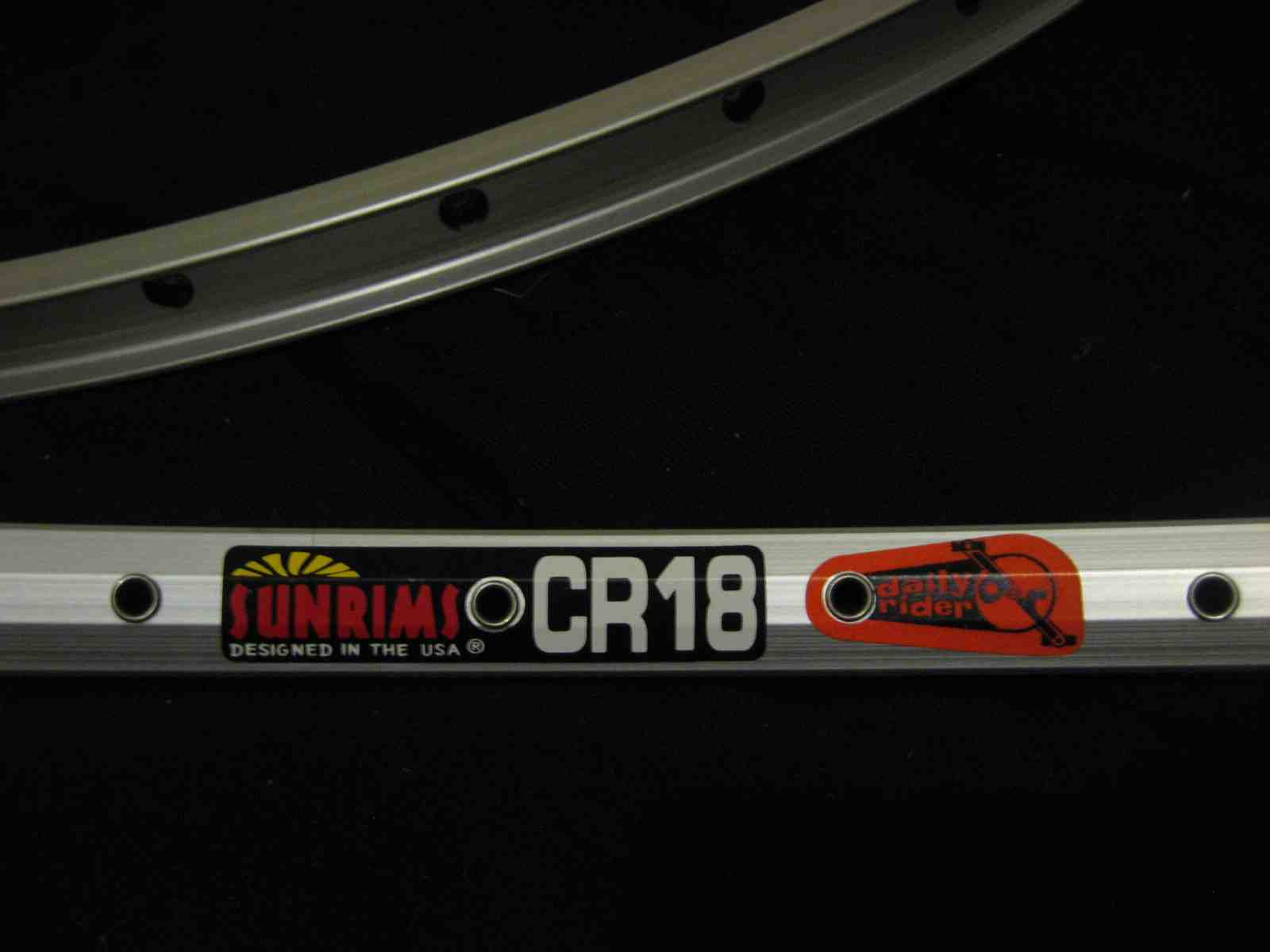 The choice of a pair of Sun CR18s as my new rims was an easy one. They have a great reputation, can be found online for short money and they are approved for touring and tandems. Mine were found at a discount for cosmetic reasons- slightly flawed anodizing on the braking surface is barely noticeable and will disappear as I ride the bike anyway. These rims should be more than sturdy enough for my planned trip and all subsequent flogging.
The original hubs are nothing special. It would make more sense and be more cost-effective to toss the wheels altogether and find a decent replacement set on sale, but that wouldn't be in keeping with my original goals to save as much of Dad's original bike as I could and learn new skills through this project. A "Joytech 95D" loose-ball bearing hub up front and a Shimano Acera cassette hub out back have gotten the job done for over 15 years now. I've been pretty good about cleaning and repacking the ball bearings over the years, so a new set of bearings should make them once again good-as-new.
I took the old wheels apart. While cutting is a popular method to quickly and conveniently liberate a hub for reuse, I loosened and disassembled the wheels spoke-by-spoke so as to reverse-glean some understanding as to how a laced wheel is held together. This gradual reduction of tension (versus the sudden release of cutting) also reduces stress on a hub if you are planning to reuse it. I set aside a couple of spokes in case they were needed for length-matching purposes (they weren't), and a few more because used spokes have a host of other uses. I noticed that the spokes were a tad long on the front wheel, ending slightly proud of the outermost part of the nipples. Between that and the slightly smaller inner diameter of the new rims, I reasoned that the new spokes should probably be 2 or 3 mm shorter than the originals. I planned on buying the spokes locally, figuring it would be a good way to glean some tips and expertise from more wheel-savvy mechanics. DT Swiss and Wheelsmith seemed like the best-loved and most widely available quality spoke choices, but I figured I'd just use whatever they used at a knowledgeable shop. I wound up at Central Wheel, where Dave was cool and helpful and served as translator/go-between for the wheel guy, who for some odd reason wouldn't address me directly from 10 ft away (that was kind of weird, actually...). The wheel guy simply went ahead and entered the measurements of my old hubs and new rims plus the lacing pattern (cross two) into some fancy spoke calculating thingie. The results were 72 spokes labeled for their front and rear positions plus a bag of nickel-plated brass nipples. All these elements will come together to form some wheels in the near future. I'll keep you posted.
Read more!
I planned on buying the spokes locally, figuring it would be a good way to glean some tips and expertise from more wheel-savvy mechanics. DT Swiss and Wheelsmith seemed like the best-loved and most widely available quality spoke choices, but I figured I'd just use whatever they used at a knowledgeable shop. I wound up at Central Wheel, where Dave was cool and helpful and served as translator/go-between for the wheel guy, who for some odd reason wouldn't address me directly from 10 ft away (that was kind of weird, actually...). The wheel guy simply went ahead and entered the measurements of my old hubs and new rims plus the lacing pattern (cross two) into some fancy spoke calculating thingie. The results were 72 spokes labeled for their front and rear positions plus a bag of nickel-plated brass nipples. All these elements will come together to form some wheels in the near future. I'll keep you posted.
Read more!
Tuesday, April 13, 2010
Postcard: A Great Day in Harlem,or Some Days The Bike Rides You

 After all the hassle surrounding my attempt to purchase a headset locally, the one I ended up with still didn't fit (the fork crown race had a too-small inner diameter for my fork) so there was no chance I was going to have the Trek together in time for Saturday morning. By Friday evening, I was tired and disappointed. My plans for the day had pretty much fallen apart.
 The Blessing of the Bikes was not only held on the first anniversary of Dad's passing but a mere three blocks south of St. Luke's Hospital, where he spent most of his last days. The coincidence of all these things was too great for me to pass up. Besides that, I needed a day away from home and the weather was supposed to be fantastic. I decided I was going to New York no matter what, and the bike was coming with me.
 Time for a contingency plan. As it happened, Schleppi was bound for Newton, Mass on Saturday, so I walked over to her house with the Trek fork and a note for the good folks at Harris Cyclery. I relaxed, confident that this matter would now be in competent hands. I grabbed the day pack I use for backcountry snowboarding and attached the bare bike frame in seconds. It couldn't have worked much more smoothly-- or looked much more ridiculous.
I caught a pre-dawn lift to New Haven from friends en route to catch a morning flight to Guatemala. I took Metro North to the 125th St station. Harlem's main drag was still sleepy and quiet as I strolled westward through Morningside Park to the Cathedral of St. John the Divine. A steady stream of bikes were arriving at 9 AM and being carried up the Cathedral's massive front stoop. A charmingly stubborn older woman refused my offer to help carry her ungainly vintage Triumph 3-speed up the stairs. Her friend rolled her eyes and chuckled. The overall mood was warm and good.

 The ceremony was fairly short, the perfect blend of lighthearted and solemn. Words were said, holy water sprinkled, dead cyclists memorialized, bagpipes played, many pictures taken. The ceremony concluded with a procession around the enormous Gothic cathedral, with much lingering and milling about afterward, both inside and out. I chatted with a bunch of people as I made my way to a bench to enjoy a bagel and a coffee in the late-morning sun. There were at least two other unrideable and incomplete bikes in attendance, so the yoke of ridiculousness was shouldered by more than just me.
 I wandered the area for the next few hours, walking around Columbia University, Morningside and Marcus Garvey Parks, and savoring the food, culture and architecture that abound across 110th St. The chromoly frame strapped to my back was virtually unnoticeable to me as I walked, though I was asked nicely to leave it in the coat check at the Studio Museum. I made my way back to Hartford by late afternoon, but not before getting a bike permit for the Metro North train. It's not needed for a bare frame or a folding bike, but I will need it to ride the train with a full-sized bike. I ponied up the $5 fee as both an incentive and a promise to be back again soon.
Read more!
I wandered the area for the next few hours, walking around Columbia University, Morningside and Marcus Garvey Parks, and savoring the food, culture and architecture that abound across 110th St. The chromoly frame strapped to my back was virtually unnoticeable to me as I walked, though I was asked nicely to leave it in the coat check at the Studio Museum. I made my way back to Hartford by late afternoon, but not before getting a bike permit for the Metro North train. It's not needed for a bare frame or a folding bike, but I will need it to ride the train with a full-sized bike. I ponied up the $5 fee as both an incentive and a promise to be back again soon.
Read more!
Friday, April 9, 2010
Deez Locknutz- A Rant
 Tomorrow, April 10 is the Blessing of the Bikes in New York. It also happens to be the first anniversary of my father passing away. The overhaul of his old Trek had fallen by the wayside in the face of more prosaic things like house repairs, etc. and still sat scattered about the apartment as of yesterday. The coincidence of the two aforementioned events seemed too significant to pass up. I began a sudden fit of bike fixing with the goal having the Trek ready to ride by Saturday morning. I had accumulated most of the parts I needed to fix it up, but still needed a couple of thing to get the job done, the most important one being a new headset, as the original one was thoroughly done.
I called some area bike shops yesterday afternoon to see who had a new 1" threaded headset in stock. The first shop reacted as if I had called up looking for French-threaded tandem cranks. Threaded headsets are NOT THAT RARE, people! Sheesh! Strike two was more sympathetic, immediately offering to order me one. Finally, a shop said they had one, so I headed for their suburban location. The shop was busy. This is a good thing in the sense that many people are excited about riding bikes, but a bad thing in that customers were getting a bit backed up. None of the parts I came for were in the retail area, so I had to wait. Aaaaand wait. The owner apologized. Then I waited some more. I did finally get the headset, a BMX-style Odyssey Dynatron. I liked that it had upgraded bearings and a nice rubber seal to protect the vulnerable bottom bearing race. I also liked that it sounded like an option on a 1950's Buick. While there, I got some brake cable housing and a couple of other parts that I needed asap. By the time I got out of there, I was in a rush, running late for my weekly farmers' market gig back in Hartford.
I made two annoying discoveries last night when I finally went to work on the bike. First, my cable housings were not in the bag from the store; second, the headset was missing a locknut, rendering it useless. Grrrr.
I returned to the bike shop this morning. The person who had sold me the parts yesterday recognized me immediately. "You forgot your cable housing!" he announced across the room. While I happen to think that it was not so much that I forgot it as much as he had failed to put it in the bag with the rest of my purchase, I nodded and thanked him for the housing. I then showed him the headset I had purchased yesterday sans locknut. He seemed puzzled at first, but then asked a mechanic to find one. The mechanic returned with a gouged used locknut that looked like it had been  attacked by a wilding gang of angry Vise-Grips. I indicated that I wasn't happy with this and he went on another search, eventually returning with a shiny new one. At this point, I was again late and running out of patience, so I thanked him and left. I later looked closely at the new nut and saw that it was really cheaply made, had a built-in fake "spacer" and lacked the nice rubber seal that the Odyssey headset components featured. Unwilling to make another trip, I dug through my stash of derelict bikes and found a Trek 730 with a Tange headset that yielded a higher quality locknut. It's a little beat-up, but it will do the job.
This was a minor annoyance, but still kind of a stupid, unnecessary ordeal. While it's true that threaded headsets are not as common these days, there are still brand-new bikes ranging from big-box store crap to $2,000.00+ Rivendells that come equipped with them. Many of the bikes I see in daily use around Hartford are 10-30 years old and are likely to need replacement parts from time to time. Indeed, they are MORE likely to need such parts than a late-model bike with a modern threadless fork, yet everyone in the area has the threadless parts in stock. Finally, offering a customer mangled or substandard replacements for parts missing from a brand new item he has already purchased is really lousy customer service.
Read more!
Tuesday, January 12, 2010
Dad's Trek: the series

This is the kick-off post for my overhaul of one battered Trek 720. I see a lot of bikes of this vintage around town, and many, if not most, of them are in poor condition. I've lost track of how many times I have seen neglected 80's and 90's bikes with one cantilever brake missing or dangling loose (occasionally both!). I cringe when I hear the clacking of rusty chains and dry bearings on one of the aging Peugeots or Univegas in my neighborhood that have gone from bike-boom glory to hard-luck mount. I also see a lot of cheap big-box-store type bikes around here, and I think people would do better to fix up decent-quality older bikes than to keep buying really crappy new ones. I have had conversations with people who have spent many hundreds of dollars getting bikes like these extensively fixed up. I hope this series will prove useful for those who have put off needed repairs or maintenance for fear of racking up big repair bills when money is tight. If you are loaded and flush with cash, by all means show some love for our area bike shops. We like having them around.
Here are my basic goals for this series and this project:
- Make the bike as good as new mechanically, upgrading components as needed.
- Reusing parts when possible without compromising safety or durability. This will be as much for the sake of reducing waste as for the sentimental goal of saving what can be saved of the original bike.
- Getting the bike ready for one loaded tour and for many more years of daily service.
- Learning some new skills, strengthening some existing knowledge, and sharing this learning process on the Beat Bike Blog.
Soon, I'll finish disassembling the bike and see exactly what needs to be done. I have already accumulated and set aside some new and used parts for it over the past several months, so I need to dig those out and remember what I have. Next, I'm going to strip it down to the frame and get that into shape for reassembly. In my next installment, we can see what I find. I'll get back to you soon. Read more!
Tuesday, January 5, 2010
My Favorite Bike

I have owned dozens of bicycles, and I have pined for and fantasy-built hundreds more. If someone asks me which is my favorite however, the answer is easy. It is this beat-up mid 1990's Trek 720. It's a 700c wheel hybrid that gradually acquired fenders, smooth tires and cut-down straight handlebar during its evolution toward daily beater/ city bike status. It is not particularly cool or aesthetically pleasing. Nobody looks at it and says, "Hey, nice bike!" A couple of years back, I was walking out of the annual Warren Miller film at The Bushnell with a small group of friends. One of the group, an avid cyclist from the suburbs asked with concern if I was under a constant threat of bike theft. I told her that I felt my bike was pretty safe. She was unconvinced until we reached the Trek locked to a signpost. "Oh, I see what you mean." she said.
In popular cycling lore, hybrids vie with "comfort bikes" as the dorkiest thing this side of a recumbent. I don't care who scoffs at it, I like it. This is my favorite bike because it has proven sturdy and reliable through hard, year-round usage in all kinds of weather. Finally, most significantly, this bike is an emotional favorite. Its sentimental value is off the charts.
This was my father's last bike. My parents introduced me to cycling as a passenger around the age of two (the same year they first put me on skis) Around the age of 5, I got my own bike, a hand-me-down moss green Ross banana seat bike of a late 60's vintage. I grew up riding the streets and county park pathways with Mom and Dad, listening to the reassuring Sturmey Archer song tick-tick-ticking away on their matching brown his and hers early 70's Raleigh Sports 3 speeds (if his had not been sold at a family garage sale unbeknownst to me, it would be hands-down my favorite bike). When my Dad was approaching 70, he wanted more gearing choices for his aging knees, so he and my Mom bought a pair of 21-speed Trek 720 hybrids. By his late 70's his knees didn't feel up to bike riding anymore and he handed the well-preserved 720 off to me. I proceeded to give away the old Shogun road bike that had been my previous commuter and began riding the Trek full-time.
My father passed away this past April several days after turning 83. He was active to the end (mad props: he continued skiing through the age of 81), felled by a massive heart attack in Manhattan as he spent a night on the town with Mom for his birthday. We miss him terribly, but take great comfort and great example from a life well-lived. We should all do so well. By this past spring, Dad's old Trek was a bit tired. Years of rain and road salt and hard usage had worn out two drivetrains and left two pairs of rims with gouged sides and rusted spokes. It seriously needed an overhaul, and as I began collecting new parts for it, I had an idea. My father was born in New Bedford, Massachusetts and lived his last decades in Glen Rock, NJ, with a quarter century or so spent in Brooklyn in the middle. I decided it would be both a fitting tribute and generally therapeutic for me to ride Dad's old bike from Glen Rock to New Bedford (via Brooklyn, of course) staying with friends and relatives or camping out along the way. This past Memorial Day was to be the original start date (apropos for honoring a WWII veteran) of my trip, but an employment opportunity arose that would have been foolish to pass up (I was unemployed at the time--2009 was not my favorite year in several ways). I began to disassemble the bike and got no further.
 So now the bike sits in pieces, and I admit I've hit something of a mental block. I have a daunting surplus of goals stacked up for 2010 but I'm going to deem making this bike function again one of my first short-term resolutions. In addition to getting my cherished beater back on the road, I think this could be a fine opportunity to write some step-by-step how-to articles for the Beat Bike Blog. I think I will start with the wheels. I recently got a good deal on a new pair of Sun CR18 36 hole rims and have already spoken to a local shop with a solid inventory of spokes and knowledge. I plan on paying them a visit soon, and I'll surely keep you posted.
Read more!
